
NEURO
Unlock the brain.Keep the molecule.
Apertum primes the blood-brain barrier with non-invasive stimulation—so systemic therapeutics reach the CNS without being redesigned.
↓01 / No surgery02 / No microbubbles03 / No nanoparticles04 / Molecule unchanged
01 / The constraint
Biology can work.
Delivery can fail.
The blood-brain barrier protects the brain—and blocks most therapeutic molecules from reaching useful exposure.
Apertum treats permeability as a platform problem. The goal is to unlock existing and next-generation therapeutics without redesigning the asset around the barrier.
02 / The platform
The device is not
the product. Delivery is.
A clinical workflow built to fit around the therapeutic—not force the therapeutic to fit around the technology.
Prime
A 45-minute non-invasive stimulation session transiently increases BBB permeability.
Infuse
The device is removed and the existing therapeutic is administered through a standard systemic infusion.
Deliver
The temporary permeability window increases exposure inside the central nervous system.
Discharge
The workflow is ambulatory—with no sedation, shaving, implanted device or hospital stay.
03 / Preclinical signal
Across species.
Into deep structures.
Systemic AAV–ARSA administration with Apertum treatment produced region-specific enzyme activity increases versus a no-opening control in non-human primates.
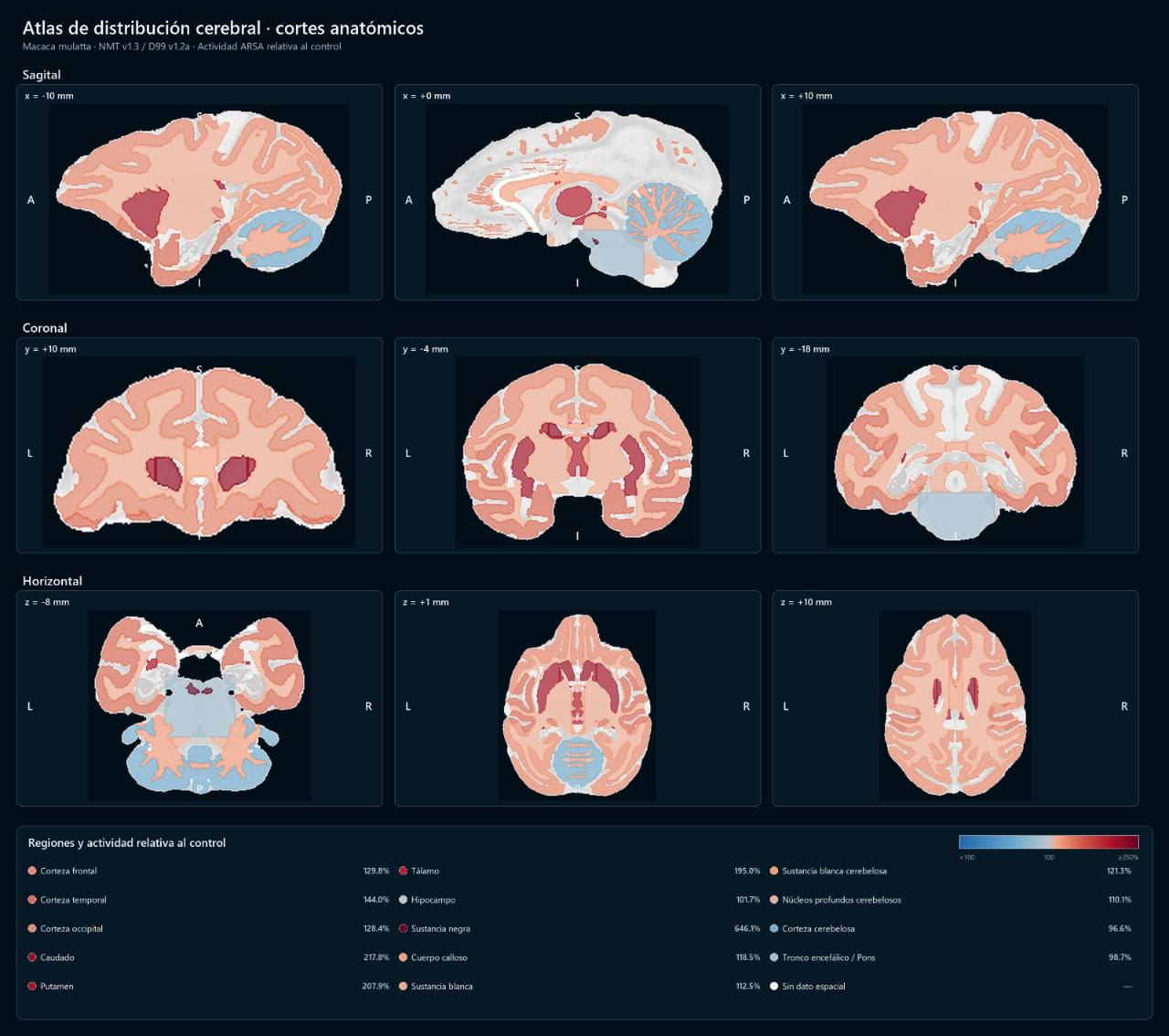 Regional ARSA activity map · Macaca mulatta
Relative ARSA activity / control
Substantia nigra646.1%
Caudate217.8%
Putamen207.9%
Thalamus195.0%
Temporal cortex144.0%
Frontal cortex129.8%
Evidence ladderRodent efficacy & reversibilityPorcine permeabilityNHP functional AAV–ARSA signal
Regional resultActivity increased across cortical, basal-ganglia and thalamic regions.Substantia nigra reached 646.1% of the no-opening control.
Research access
Follow the evidence further.
04 / One platform, multiple assets
Prime a temporary delivery window for approved or clinical-stage compounds whose useful CNS exposure is limited by the barrier.
Platform value · Increase exposure without changing the compound.Create a route for large biologics to enter the CNS while preserving the molecule’s binding architecture and systemic administration.
Platform value · Improve tissue-level antibody exposure.Use BBB priming before systemic AAV delivery to investigate broader access to deep brain structures. AAV–ARSA is the platform’s current functional NHP signal.
Evidence anchor · Non-human-primate AAV–ARSA activity mapping.Apply the same workflow to gene-replacement and nucleic-acid programs where distribution—not construct design—is the central constraint.
Platform principle · Keep the therapeutic design; change the access condition.05 / Path to the clinic
A measurable first step.
A platform beyond it.
The beachhead is brain oncology: use clinically planned resection to measure whether BBB priming changes drug exposure, then evaluate repeat-use safety.
Now01
Preclinical platform
Rodent reversibility, porcine permeability and NHP functional AAV–ARSA proof-of-concept.
Next02
Phase 0 delivery
Quantify systemic-therapy exposure in resected tissue from recurrent GBM and brain metastases.
Then03
Phase 1b safety
Evaluate repeat-use safety, feasibility and early clinical activity alongside standard systemic therapy.
Scale04
Therapeutic partnerships
Expand modalities and collaborate with teams whose CNS assets remain limited by delivery.
First human objective
Quantify the increase in CNS drug exposure and establish repeat-use safety inside an existing clinical workflow.
Recurrent GBM & brain metastasesPlanned tissue resectionLC–MS/MS quantification
06 / Built by repeat neurotech founders
From device
to delivery.
Founded by the team behind Actipulse Neuroscience, Apertum brings operating experience in neuromodulation, clinical workflows and neurotechnology commercialization.
9+ years in neurotech600+ devices deployed15k patients treated
Meet the founders →07 / Collaboration
Have a CNS molecule
stopped at the barrier?
We are looking for biotechnology and pharmaceutical partners building therapies whose biology is ready—but whose delivery is not.
Start a conversation ↗08 / Full platform brochure
Go deeper than
the landing page.
The 33-page brochure covers the preclinical evidence ladder, NHP ARSA readout, first-in-human program, regulatory path, commercial models and financing plan.